
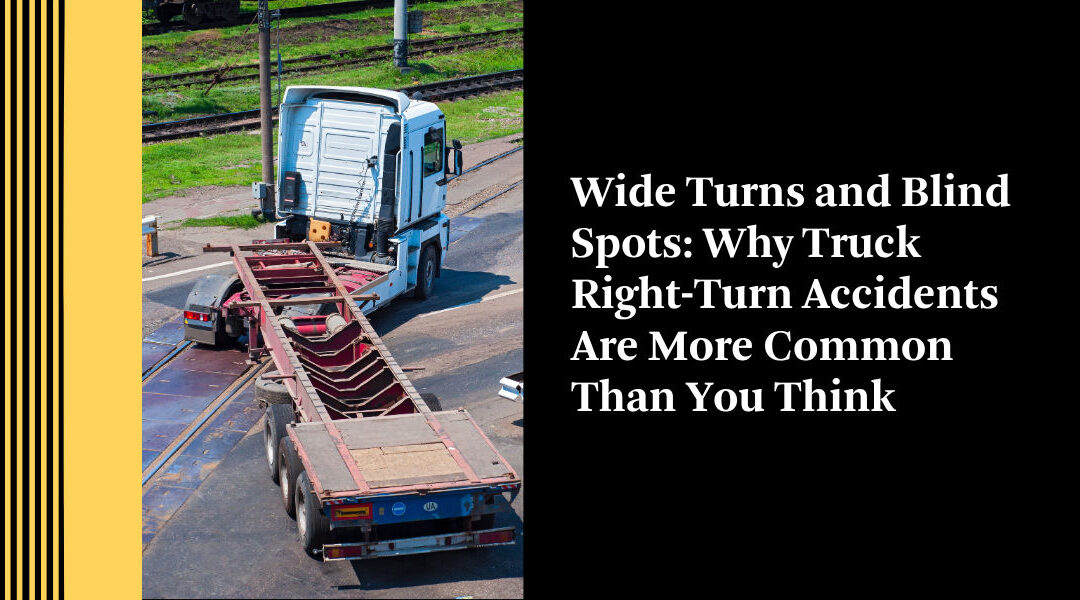
Anyone who has driven behind an 18-wheeler at a busy intersection has seen it. The truck pulls partway into the left lane, brake lights flash, and then it swings hard to the right, taking two lanes at once to make a turn that a passenger car could handle without a second thought. Most of the time, this maneuver goes smoothly. When it does not, the results can be catastrophic for whoever happens to be in the wrong spot.
Right-turn truck accidents are one of the most consistently underestimated causes of serious wrecks in Missouri. They happen at intersections all over Joplin and Columbia, on Rangeline Road, along Stadium Boulevard, at the exits off I-44 and I-70, and just about anywhere a semi has to negotiate a turn built for a Toyota Camry. Understanding why these crashes happen, and who is really at fault when they do, matters more than most drivers realize.
Why Trucks Have to Turn So Wide
An 18-wheeler is not just a bigger version of a car. It is a two-piece vehicle with a cab up front, a trailer behind, and a pivot point in between. When the driver turns the steering wheel, the trailer does not follow the same path the cab takes. It cuts the corner. This is called offtracking, and every commercial truck driver is trained to compensate for it.
The compensation is the wide turn. To keep the trailer from running up onto the curb, over a stop sign, or through a line of stopped cars, the driver swings the cab out to the left before turning right. Done properly, this maneuver clears space for the trailer to follow through cleanly. Done improperly, or done without checking blind spots, it can trap a passenger vehicle in a space the driver did not realize was occupied.
The Blind Spots Are Bigger Than You Think
Commercial trucks have four major blind spots, and the one on the right side is the largest and most dangerous. It extends from the passenger door of the cab all the way back along the length of the trailer and out several lanes wide. A driver in that zone is essentially invisible from the driver’s seat of the truck, even with properly adjusted mirrors.
That is why so many right-turn wrecks happen. A passenger car pulls up on the right side of a truck at a red light, sitting in the driver’s blind spot. When the light turns green and the truck starts its wide right turn, the trailer sweeps across the intersection and crushes the car against the curb, a light pole, or another vehicle. From the truck driver’s perspective, there was no car to begin with. From the passenger car’s perspective, the truck came out of nowhere.
Who Is Actually at Fault
There is a common assumption, encouraged by trucking insurance defense attorneys, that if you were in the truck’s blind spot, the wreck must be your fault. Missouri law does not work that way.
Commercial truck drivers are held to a higher standard than ordinary drivers. They are trained on blind spots, they know their vehicles cannot maneuver like passenger cars, and they are required to check their mirrors and signal properly before every turn. When a truck driver initiates a wide right turn without confirming that the space to their right is clear, that is negligence. When a trucking company fails to properly train its drivers on blind spot management or fails to maintain functioning mirrors and cameras, that is negligence too.
Missouri follows a pure comparative fault rule, which means even if a jury decides you share some responsibility, you can still recover. But in most right-turn truck cases, the driver’s obligation to check the lane they are about to sweep through is where the analysis actually starts. Modern trucks are often equipped with side-mounted cameras, blind spot detection systems, and telemetry data that can show exactly what the driver saw, or should have seen, in the moments before the crash. Getting that evidence preserved quickly is critical.
The Injuries Are Often Severe
A car caught in a truck’s right-turn path rarely comes out of it lightly. Being crushed against a curb, dragged along a trailer, or pinned between the truck and another fixed object can cause spinal injuries, traumatic brain injuries, broken bones, and long-term disability. Cyclists and pedestrians in crosswalks are even more vulnerable, and these wrecks are one of the leading causes of pedestrian fatalities in commercial truck crashes nationwide.
Because the trucking company is almost always involved as a defendant, insurance coverage tends to be substantial. Federal minimums for interstate motor carriers start at $750,000 and often go much higher. But those policies are protected by aggressive defense teams whose job is to minimize what gets paid out, which is why representing yourself in one of these cases rarely works out.
What to Do If You Have Been Hit in a Truck Right-Turn Wreck
The same principles that apply to any serious wreck apply here. Call the police, document the scene, get medical attention the same day, get witness contact information, and be careful about what you say to any insurance representative. But there is an added layer of urgency in truck cases. Trucking companies are often required to preserve certain records for only limited time periods, and driver logs, dashcam footage, and telemetry data can disappear if legal notice is not sent quickly.
With more than 45 years of experience and over $200 million in settlements and judgments, Sticklen & Sticklen has handled truck and 18-wheeler cases across Boone County, Jasper County, and the highways in between. If you or a loved one has been hit by a truck making a right turn or any other commercial vehicle maneuver, call our Joplin office at (417) 626-9880 or our Columbia office at (573) 303-3848. You can also learn more about how we handle these cases on our 18-wheeler and tractor trailer accidents page. Consultations are free, and there is no fee unless we recover for you.